
The cheetah is famous for one extraordinary ability—speed. As the fastest land animal on Earth, it can accelerate faster than many sports cars and reach remarkable speeds in just a few seconds. But raw speed alone does not explain why the cheetah is such an efficient hunter. Every part of its body has evolved to maximize acceleration, agility, and balance during a chase.
From its flexible spine to its unique claws, the cheetah is a masterpiece of natural engineering. Understanding these adaptations makes every cheetah sighting on safari even more fascinating.
A cheetah can reach speeds of up to 100–104 km/h (62–65 mph) under ideal conditions, making it the fastest land mammal on the planet. However, these incredible bursts of speed last only around 20 to 30 seconds because sprinting requires an enormous amount of energy.
Instead of relying on endurance, cheetahs depend on explosive acceleration to catch prey before exhaustion sets in.
Unlike lions or leopards, cheetahs are built almost entirely for running.
Cheetahs have exceptionally long and lightweight limbs that allow them to cover several metres with every stride. Powerful hind leg muscles generate explosive acceleration, helping them reach top speed within only a few seconds.
One of the cheetah’s greatest advantages is its highly flexible spine. During a sprint, the spine bends and stretches like a spring, dramatically increasing stride length. At full speed, the animal’s body extends and contracts with every leap, creating smooth, efficient movement.
Compared to other big cats, cheetahs have slender bodies, relatively small heads, and reduced body weight. Every kilogram saved helps improve acceleration and reduces the energy required during a chase.
Most cats have fully retractable claws, but the cheetah’s claws remain partially exposed. Rather than being a disadvantage, this provides additional grip on loose soil and grass.
These claws function much like the spikes worn by professional sprinters, allowing the cheetah to maintain traction while accelerating, turning, and braking at high speed.
A cheetah’s long muscular tail plays a crucial role during a hunt.
When prey suddenly changes direction, the tail acts as a counterbalance, helping the cheetah make sharp turns without losing control. This remarkable agility often proves more valuable than top speed, especially when pursuing fast and unpredictable antelope.
Unlike many other large cats that hunt mainly after dark, cheetahs rely heavily on excellent daytime vision.
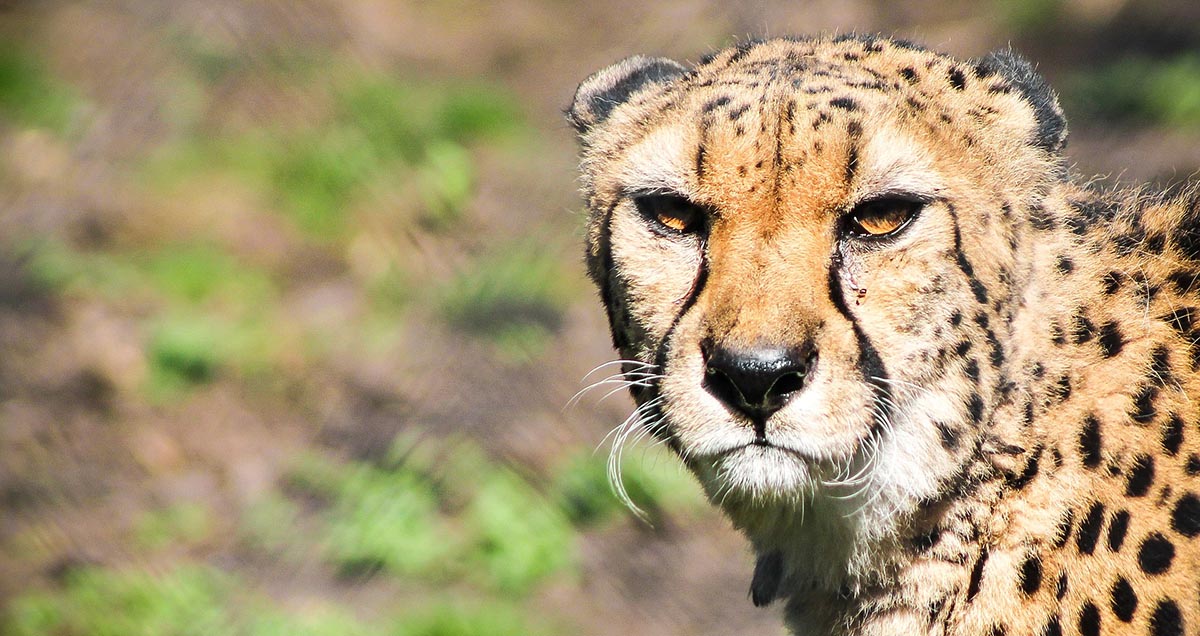
Their eyes can detect movement from great distances, allowing them to identify suitable prey before beginning a careful stalk. The distinctive black “tear marks” running from the eyes to the mouth reduce glare from the bright African sun and help improve focus during daylight hunts.
A sprint places enormous demands on the body.
Cheetahs possess enlarged lungs, oversized nasal passages, and a powerful heart capable of delivering oxygen rapidly to working muscles. During a chase, breathing rate and heart rate increase dramatically, providing the oxygen needed to sustain those incredible bursts of speed.
Despite their extraordinary abilities, cheetahs cannot maintain maximum speed for long.
High-speed running generates tremendous body heat and quickly depletes energy reserves. If the hunt is unsuccessful after a short sprint, the cheetah usually abandons the chase rather than risking exhaustion.
After making a kill, it often spends several minutes resting and recovering before feeding.
Although cheetahs are the fastest land animals, hunting remains challenging.
Their preferred prey includes Thomson’s gazelles, impalas, and other medium-sized antelope. Even with their remarkable adaptations, successful hunts depend on timing, surprise, and agility as much as raw speed. Once the chase ends, larger predators such as lions and spotted hyenas may attempt to steal the kill, forcing the exhausted cheetah to retreat.
Several destinations offer excellent opportunities to observe cheetahs in their natural habitat.
Some of the best locations include:
Open grasslands provide the perfect environment for these speed specialists to spot prey and launch high-speed pursuits.
Reliable scientific measurements place the cheetah’s top speed at approximately 104 km/h (65 mph), although older claims of higher speeds are no longer considered accurate.
Lions, leopards, and tigers rely more on strength and ambush than sustained pursuit. Their heavier, more muscular bodies are designed to overpower prey rather than outrun it.
Not over long distances. While few land animals can match a cheetah’s acceleration, it can only sustain top speed for a short period before tiring.
The cheetah is far more than simply the world’s fastest land animal. Every feature—from its flexible spine and lightweight body to its specialized claws and remarkable eyesight—has evolved for one purpose: capturing prey in open landscapes with incredible precision.
Watching a cheetah sprint across the African savannah is one of the most unforgettable wildlife experiences you can have. It is a perfect example of evolution producing an animal uniquely adapted to its environment, making the cheetah one of Africa’s most extraordinary predators.

No worries! Every package we offer is simply a starting point, as we know each traveler has unique needs. Reach out to us through our inquiry or contact form, and we'll craft a personalized safari experience just for you.